{{ data.msg }}

Your browser does not support all of our website’s functionality. For an improved shopping experience, we recommend that you use the most recent versions of Google Chrome, Safari, or Firefox.

Zugehöriges Bild

ONE PHILOSOPHY

RockShox’s LinearXL air spring and Specialized GENIE’s technology were built by different teams chasing a similar feeling. Between them, the conviction is the same: a linear air spring in the first two-thirds of the spring curve means predictability, and increased bottom-out control in the last third means support when you need it most. Let’s look at how RockShox and Specialized came together to create the new GENIE platform.

In the past, air springs have felt relatively unpredictable when you need them most. The problem is physical: engineers have always been constrained by the air spring's design when trying to shape its curve. RockShox spent the last few product cycles reshaping the constraints.

Zugehöriges Bild

A spring curve is a map of how much force it takes to move a fork or rear shock all the way through its travel. Coil springs are linear: each millimeter of travel requires the same additional pound of force. For example: if 10mm of travel requires 25 lbs of force, 20mm would require an additional 25 lbs of force, etc. This is also why you can use up all your travel with no warning at the end.

Air springs have historically done the opposite: more force to initiate travel, becoming soft in the middle, then ramping up at the end—three distinct parts of a whole curve RockShox engineers call the "nose”, “hammock”, and "ramp." Tunable and light, sure. Consistent like coil? Not quite. The question worth asking: what if we didn't have to choose?

Zugehöriges Bild

THE GOAL

RockShox’s goal was to split the spring’s job into two: stay consistent where riders spend most of their time (mid travel), and be supportive where they need it most—at the end of travel. Six products emerged from RockShox's latest development cycle—BoXXer, ZEB, and Lyrik forks; Super Deluxe, Vivid, and Vivid Coil rear shocks, each one rebuilt around a single concept: predictability, so riders know exactly how their fork or shock will respond to trail features.


On rear shocks, that translates to a linear curve for the first two-thirds of travel, before the curve ramps up in the final third for bottom-out resistance, controlled by Hydraulic Bottom Out on Super Deluxe, Adjustable Bottom Out on Vivid and Vivid Coil.


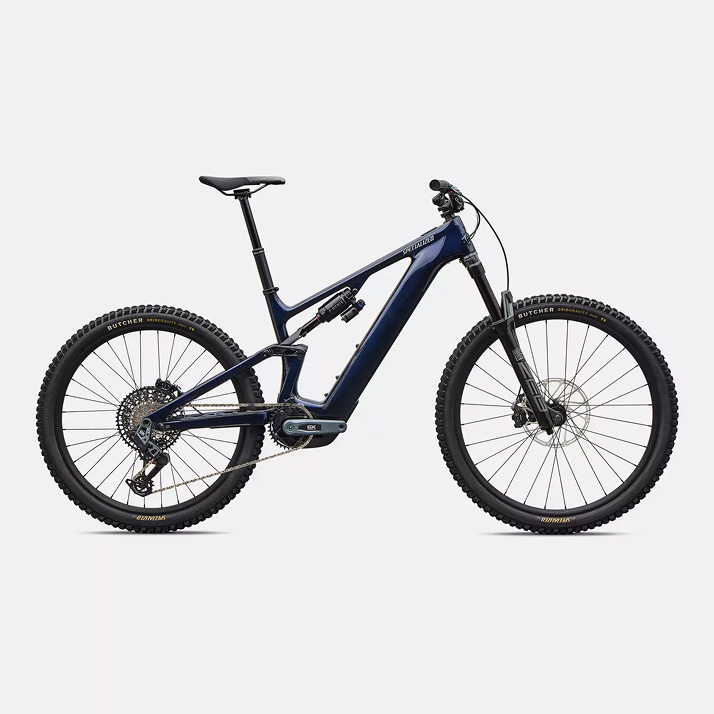
It's a theory already proven across an entire lineup. Now we’re going a step further—tuning a rear shock specifically for Specialized’s Stumpjumper, Levo R, and Levo 4’s kinematics. Learn more about linear air springs.

Specialized Genie RockShox

MEET GENIE.

Developed by Specialized and brought to life by RockShox, the new Super Deluxe GENIE is built on a shared belief that riders feel more in control, ride longer with less fatigue, and hit bigger features with confidence when their suspension runs a linear-like spring rate with robust bottom-out support. The same logic behind LinearXL, now tuned for Specialized.

"The goal wasn't to make the shock more progressive everywhere," says RockShox Design Engineer Chris Golkiewicz. "It was to keep the beginning of the travel more linear, then introduce progression later when riders actually need it."

At the core of Super Deluxe GENIE is a dual-stage air spring system, built around a higher-volume air can, a second piston, and the GENIE sleeve. The higher-volume air can means that GENIE runs a higher starting pressure than a standard Super Deluxe to reach the same sag, and the payoff is a flatter, more linear curve through the first two-thirds of travel.

Zugehöriges Bild

Then, around 70% into travel, the second piston (black anodized piston in the image above) enters the sleeve (red anodized sleeve), closing off that volume of air, which increases pressure to create a steeper ramp-up at the end of travel—all for a more controlled bottom-out.

Specialized R&D Manager Chance Ferro traces the idea to limitations in how spring curves are designed: "We realized with standard spring tuning we were beholden to a certain level of spring progression to reach an acceptable level of end-stroke support." GENIE breaks that dependency, letting engineers tune the first 70% of travel at its own rate, independent of the final 30%. Sound familiar? (Ahem, LinearXL)

The result, Ferro says, is a feeling that's hard to describe: "It often rides like it has more travel than it really does." He's most proud of how invisible the engineering is: "It delivers a real benefit, and it's packaged so well that it doesn't require anything special from the rider to benefit from it.”

Zugehöriges Bild

THE VERDICT

The result of RockShox and Specialized coming together is a suspension system that's supple, supportive, and predictable, combining coil-like feel with the tunability of an air shock, confident bottom-out control, and the reliability riders expect from RockShox.

SHOP GENIE BIKES

WHAT IS A LINEAR AIR SPRING?

Learn what makes LinearXL different from a traditional air spring and how it creates a more predictable, coil-like ride. Explore the technology and theory behind RockShox's new air spring, featured in the latest BoXXer, ZEB, and Lyrik forks.

Learn more